
Shoulder injury treatment Zagreb is among the most frequently requested orthopedic and rehabilitation services because the shoulder is the most mobile joint in the human body. This exceptional mobility allows us to work, exercise, and perform everyday activities, but it also makes the shoulder highly vulnerable to overload, inflammation, and tendon damage. Even seemingly harmless repetitive activities such as computer work, driving, or light physical tasks can gradually strain the shoulder and lead to chronic pain or structural injury over time.
The shoulder’s wide range of motion depends on precise coordination between bones, ligaments, muscles, and, most importantly, the rotator cuff. This group of four tendons stabilizes the joint and enables controlled movement. When these tendons are irritated, weakened, or torn, simple actions such as lifting the arm above the head, reaching behind the back, or carrying light objects can become painful or limited. Over time, small micro-injuries can accumulate and progress into significant structural damage.
Everyday movements and shoulder injury treatment in Zagreb
Many shoulder problems begin with habits that most people do not consider risky: long hours at the computer, driving, repetitive overhead movements, or even gardening. These activities can slowly overload the tendons and trigger inflammation, calcifications, or partial tears. In some cases, shoulder pain is actually referred from the cervical spine, which makes accurate diagnosis even more important.
Fortunately, modern shoulder injury treatment Zagreb no longer relies primarily on surgery. Today, most shoulder conditions can be treated conservatively through targeted physical medicine and rehabilitation combined with ultrasound-guided monitoring of tendons. This is a core strength of Preventis Polyclinic, a leading center for orthopedics and rehabilitation in western Zagreb.
Through ZagrebMed, patients can access specialist orthopedics in Zagreb and advanced physical medicine and rehabilitation, ensuring coordinated diagnosis and treatment.
Preventis also collaborates closely with specialized hospitals in Zagreb to ensure seamless access to imaging, neurosurgical consultation when needed, and surgical options in more complex cases.
Case study: massive rotator cuff tear
Patient S.M. (52) came to Preventis Polyclinic with acute shoulder pain that had lasted for two months. The pain began during relatively light gardening work, showing how even moderate strain can trigger serious tendon injury. She experienced pain both at rest and during movement, particularly when reaching or lifting objects. Routine activities such as typing, using a mouse, and driving were especially painful.
A detailed clinical examination of the rotator cuff was strongly positive on all provocation tests, suggesting significant tendon involvement. A diagnostic shoulder ultrasound then revealed a major tendon rupture, visible as a black defect measuring approximately 6.5 × 5.5 mm, corresponding to a tear affecting more than half of the tendon width.
Immediately after diagnosis, the patient began regenerative physical therapy at Preventis. The treatment was not focused only on pain relief but on biological tendon healing. Therapy aimed to increase local blood circulation, stimulate new collagen formation, reduce the tendon defect, and gradually restore functional shoulder stability. Short-term medication was used to control acute pain so that she could actively participate in rehabilitation.
Therapy was conducted intensively over three weeks at the clinic, followed by two additional weeks of individualized home exercises based on a structured protocol tailored to her condition.
Before & After ultrasound results
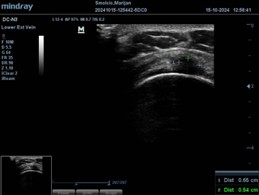
Shoulder injury treatment in Zagreb – before therapy
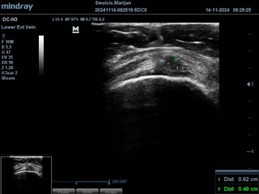
Shoulder injury treatment in Zagreb – after therapy
A follow-up ultrasound after four weeks showed 80–90% recovery of the ruptured tendon area. Clinically, the patient no longer experienced pain in normal daily activities, with only mild discomfort under extreme or sudden load. She was advised to continue modified strengthening exercises to fully restore tendon resilience and prevent recurrence.
What this case teaches about shoulder injury treatment Zagreb
This case clearly demonstrates that even large rotator cuff tears can heal successfully when treated early with structured, ultrasound-guided rehabilitation. Many patients assume that a significant tendon tear automatically requires surgery, but modern shoulder injury treatment Zagreb increasingly prioritizes conservative, regenerative approaches whenever possible.
The clinical team at Preventis Polyclinic emphasizes early diagnosis, continuous ultrasound monitoring, and personalized rehabilitation pathways. When managed in time, even severe tendon injuries can often be treated effectively without surgical intervention.
For more details about the clinic’s expertise, team, and services, visit the official Preventis Polyclinic.
This rehabilitation protocol was supervised by Tomislav Pleš, bacc. physioth., mag. cin., Head of Preventis Polyclinic, whose clinical expertise in tendon regeneration and sports rehabilitation has been central to the clinic’s success.
F.A.Q.
Yes. Many rotator cuff tears can heal with targeted, ultrasound-guided physical therapy when diagnosed early.
Most patients recover within 4 to 8 weeks, depending on tear size, therapy intensity, and adherence to exercises.
Through clinical examination and high-resolution shoulder ultrasound, which precisely visualizes tendon structure.
No. Treatment is individualized and primarily aimed at reducing pain while stimulating tissue repair.
If pain lasts longer than two weeks, worsens with movement, or limits daily activities, a specialist evaluation is recommended.