MSK Ultrasound Examination – Single Region
About
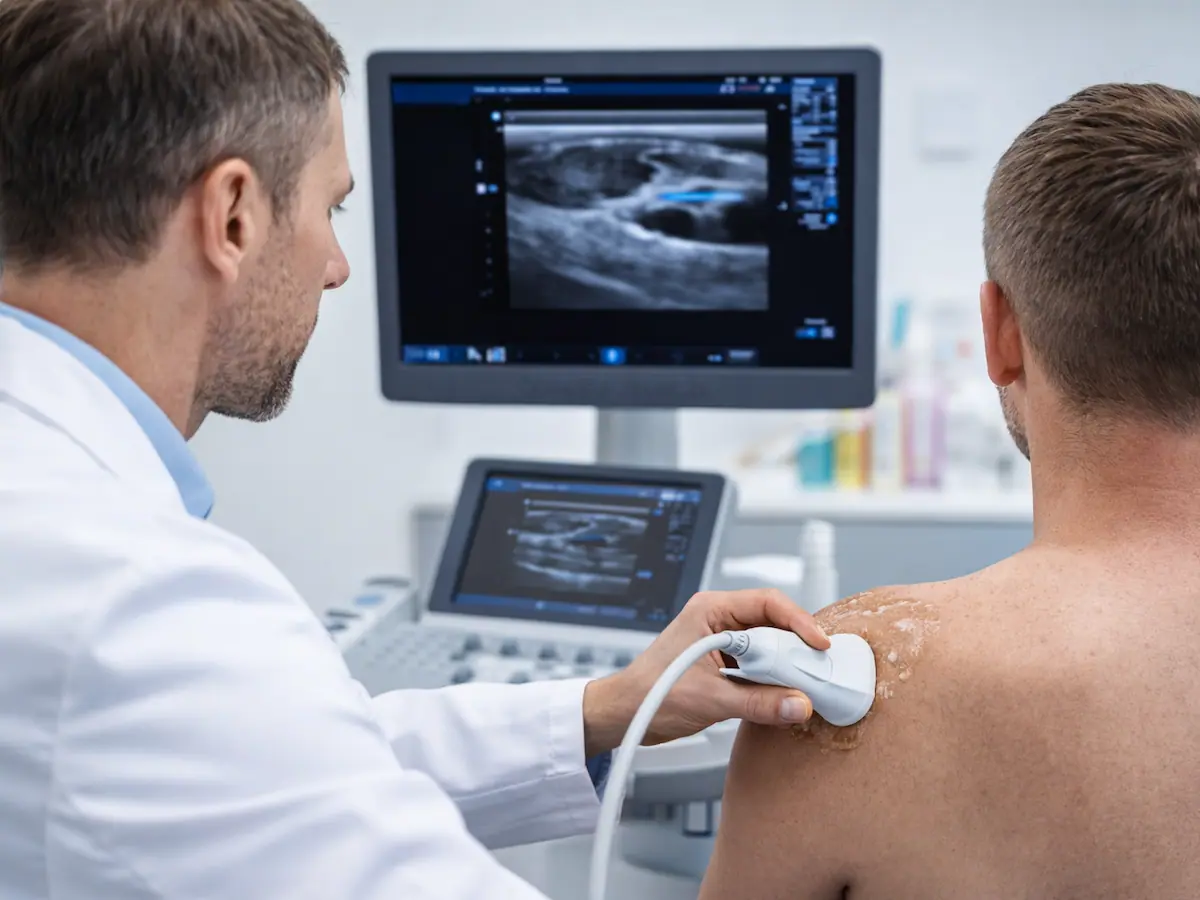
Musculoskeletal (MSK) ultrasound examination is a structured diagnostic procedure that combines clinical assessment with real-time ultrasound imaging of one anatomical region. It is primarily used to evaluate muscles, tendons, ligaments, fascia, bursae, and joint structures in patients presenting with localized pain or functional impairment.
Clinical and imaging assessment in one visit
The examination begins with a detailed medical history and symptom analysis, followed by orthopedic testing and functional evaluation of the affected region. High-resolution ultrasound imaging is then performed to visualize soft tissue structures dynamically.
Unlike static imaging modalities, MSK ultrasound allows tissues to be examined during movement. This is particularly valuable when assessing conditions such as:
- Tendinopathy and partial tendon tears
- Ligament sprains
- Bursitis
- Joint effusion
- Early degenerative changes
- Muscle injuries
Because the findings are available immediately, the examination often serves as the foundation for further therapeutic planning. If inflammatory or degenerative tendon changes are detected, targeted shockwave therapy may be recommended. In cases of myofascial overload or chronic soft tissue dysfunction, tecar therapy can be considered as part of a rehabilitation protocol.
When is MSK ultrasound indicated?
This examination is commonly indicated in patients with:
- Shoulder pain
- Knee pain or suspected meniscal irritation
- Ankle instability
- Elbow pain related to overuse
- Localized swelling or suspected soft tissue rupture
It is frequently used as a first-line imaging modality for musculoskeletal complaints because it provides immediate diagnostic clarity without radiation exposure.
Advantages of MSK ultrasound
- No ionizing radiation
- Real-time dynamic assessment
- Immediate results and clinical correlation
- High sensitivity for soft tissue pathology
- Cost-effective compared to advanced imaging in selected cases
If deeper structural pathology is suspected, additional imaging such as MRI may be recommended.
Candidate
This examination is suitable for patients experiencing localized musculoskeletal pain, reduced mobility, joint instability, swelling, or suspected tendon or ligament injury affecting a single anatomical region. It is appropriate for both athletes and non-athletes with acute or chronic complaints.
Preparation
No specific preparation is required. Patients should wear clothing that allows access to the examined region. Bringing prior imaging or medical documentation may assist in clinical interpretation but is not mandatory.
Treatment
The procedure typically lasts 20 to 30 minutes. After clinical evaluation, ultrasound gel is applied to the skin and a transducer is used to visualize the targeted structures. Findings are interpreted immediately, and a treatment plan or further diagnostic steps are discussed during the same visit.
Result
Results are available immediately after the examination. The physician explains the findings and outlines a personalized therapeutic or diagnostic strategy based on the identified pathology.
Precautions
MSK ultrasound is a safe, non-invasive diagnostic method with no radiation exposure. There are no significant risks or contraindications. In cases of complex trauma or suspected deep structural pathology, further imaging may be advised.
ZagrebMed patient reviews

I needed help while in Zagreb with quite a complex problem regarding a non-EU prescription. Ivana from ZagrebMed went above and beyond. I've rarely encountered someone so professional and kind, who helped solve a medical issue, one often far more difficult when abroad, so quickly. I cannot praise her, and as a result, the ZagrebMed, enough.
Friendly and helpful staff, fast and quality service, everything is great, I recommend it!!
F.A.Q.
Musculoskeletal ultrasound is a painless procedure. Mild pressure may be applied with the transducer during examination, but it does not cause significant discomfort.
MSK ultrasound has high diagnostic accuracy for soft tissue structures such as tendons, ligaments, bursae, and muscles. In many cases, it provides immediate and reliable assessment without the need for additional imaging.
In many cases, MRI is not required if ultrasound findings clearly identify the source of symptoms. However, MRI may be recommended if deeper structures or complex joint pathology need further evaluation.
The examination typically lasts between 20 and 30 minutes, including clinical assessment and real-time ultrasound imaging of the affected region.
MSK ultrasound and MRI are complementary imaging methods. Ultrasound is often preferred as a first-line examination for shoulder pain because it allows dynamic, real-time evaluation of tendons, bursae, and superficial soft tissue structures. It provides immediate results and is cost-effective. MRI may be recommended if deeper joint structures, cartilage, or complex intra-articular pathology require further assessment.

Send an inquiry for the treatment
Start your way towards a successful treatment today. Fill out the form with your data, choose the service you need and we will connect you with the top medical experts in Zagreb.