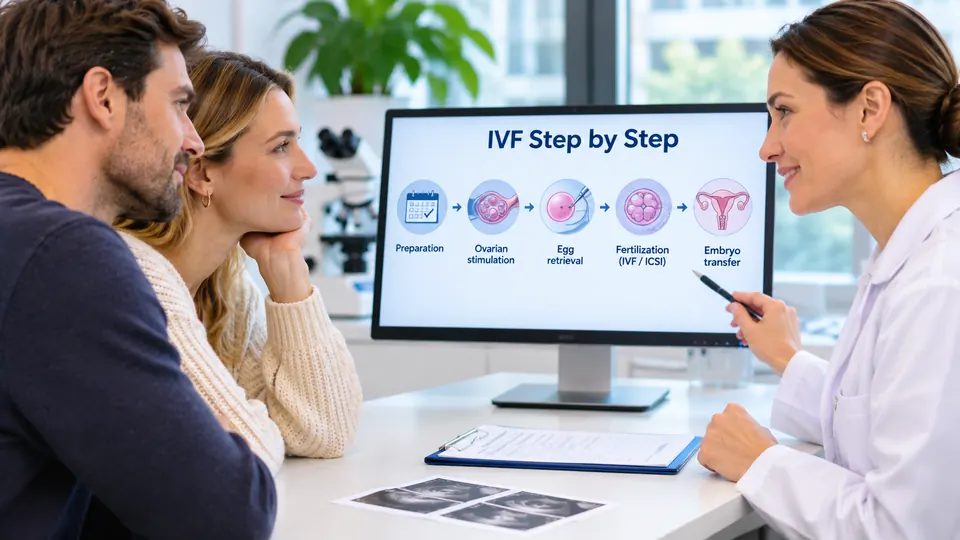
Starting in vitro fertilization (IVF) can feel like committing to a complicated calendar before you know what the appointments involve. You may hear about hormone injections, egg collection, embryo development, and transfer, but these are different stages with different decisions. Understanding the sequence can make a specialist consultation more useful and help you plan time away from work or travel to Zagreb.
A typical IVF pathway moves from fertility assessment to ovarian stimulation, monitoring, egg retrieval, laboratory fertilization, embryo development, and either fresh or frozen embryo transfer. It then continues with follow-up and pregnancy testing. Not everyone completes these steps within the same menstrual cycle. The plan may change based on ovarian response, sperm findings, embryo development, and safety. This guide explains what usually happens and which questions to discuss with the treating team.
Before IVF begins: confirming the treatment plan
IVF may be considered because of damaged or blocked fallopian tubes, significant sperm-related difficulties, certain fertility conditions, or unsuccessful previous treatment. Age, duration of infertility, reproductive history, and the availability of alternatives all matter. For some people, a less intensive approach may be reasonable first. If you are still deciding between methods, our comparison of IUI, IVF, and ICSI explains how the options differ.
Before treatment, a clinician reviews the medical history, previous cycles, ultrasound and hormone results, and the relevant semen analysis. Assessments of infection risks and other health factors may also be required according to the clinical situation and applicable rules. Ovarian reserve markers such as AMH and antral follicle count can help anticipate the response to stimulation, but they do not guarantee a certain number of eggs or predict embryo quality.
The consultation should cover the intended stimulation protocol, expected monitoring visits, laboratory fertilization method, whether a fresh transfer is planned, and the circumstances that might change the plan. You should also understand what the clinic will do if there are too few mature eggs, fertilization does not occur, or an embryo is not suitable for transfer. IVF is a sequence of decision points, not a single guaranteed procedure.
Step 1: Ovarian stimulation with a personalized plan
In a natural cycle, one follicle usually becomes dominant. IVF commonly uses medication to encourage several follicles to develop so that more than one egg may be available. The ovarian stimulation for IVF plan is selected according to predicted ovarian response, age, earlier treatments, and the risk of excessive response. Patients receive instructions on medication timing and administration from their own clinical team.
What happens during stimulation?
Stimulation often lasts around 8–14 days, although this is an approximate range rather than a fixed schedule. Medicines frequently involve injections, and additional medication may be used to prevent ovulation before egg retrieval. Monitoring appointments are arranged during the cycle. The precise number depends on the individual response, and doses or timing may be adjusted after scans or blood tests.
Some patients experience abdominal fullness, tenderness, or injection-site discomfort. Others have relatively few symptoms. Symptoms alone cannot reliably indicate how many mature eggs will be retrieved. A person with diminished ovarian reserve may respond differently from someone expected to produce many follicles. A low response does not automatically require cancellation; the decision is individualized.
Step 2: Monitoring follicles and timing final maturation
Ultrasound scans allow the team to follow follicle growth. Blood tests may be used when indicated to provide additional information about hormone levels. Follicle size is useful, but it does not prove that every follicle contains a mature egg. Doctors use the overall response to decide when to give medication that triggers final egg maturation.
Why timing matters
The final maturation or “trigger” medication is scheduled at a specific time because egg retrieval is planned shortly afterward, often roughly 34–36 hours later. The timing of the trigger and collection is part of the treatment protocol and should not be changed independently. Ask the clinic whom to contact if a dose is missed or administered at the wrong time.
Safety sometimes takes priority over proceeding with the original calendar. When the ovaries respond excessively, the clinician may change the trigger method, recommend freezing all suitable embryos for later transfer, or modify or cancel part of the cycle. ESHRE's updated ovarian stimulation guidance supports individualized prevention of ovarian hyperstimulation syndrome (OHSS), especially in patients at higher risk. Freezing embryos rather than proceeding with a fresh transfer may lower the risk of severe OHSS in selected circumstances.
Step 3: Egg retrieval and sperm preparation
The egg retrieval procedure is usually performed under ultrasound guidance with sedation or anesthesia. A clinician passes a fine needle through the vaginal wall to aspirate fluid from ovarian follicles and look for eggs. The procedure is often relatively brief, but you need time at the clinic for preparation and recovery. Follow instructions on fasting, medications, transport, and whether someone must accompany you home.
It is normal that the number of eggs collected can be smaller than the number of follicles visible on ultrasound. Not every collected egg is mature or suitable for fertilization. Mild pelvic discomfort or spotting may occur afterward. Bleeding, infection, and injury to nearby structures are uncommon but recognized procedural risks. The team should explain which symptoms require medical review and who to call outside office hours.
On or around retrieval day, a semen sample may be provided or previously frozen sperm may be prepared. If sperm quality is a concern, earlier planning is important because the embryology laboratory needs to know the intended fertilization method. Patients using donor gametes or surgically retrieved sperm may have additional preparation and consent steps, depending on the circumstances and local regulations.
Step 4: Fertilization and early embryo development
After retrieval, an embryologist examines the collected eggs to determine maturity and prepares the sperm. In conventional IVF, eggs and sperm are placed together under controlled laboratory conditions. With IVF with ICSI, an embryologist injects a selected sperm into a mature egg. ICSI can be appropriate for certain male-factor or previous fertilization problems, but it is not automatically superior for every IVF patient.
What the laboratory checks
The laboratory checks whether fertilization has occurred and follows early embryo development. Not every mature egg fertilizes, and not every fertilized egg continues developing to a stage suitable for transfer or freezing. Embryos may be assessed during the first few days and sometimes cultured to the blastocyst stage, often on day five or six. The plan depends on embryo development, laboratory practice, the number available, and clinical circumstances.
Receiving updates on embryo development can be emotionally challenging, especially when the number decreases between stages. That reduction does not necessarily mean something was done incorrectly. Embryo appearance and grading provide useful information but cannot promise implantation or a healthy pregnancy. Ask what information the laboratory will share, when you will receive updates, and how decisions about transfer or freezing are made.
Step 5: Fresh embryo transfer or frozen embryo transfer?
A fresh embryo transfer places an embryo into the uterus during the same treatment cycle as retrieval, if the clinical and laboratory conditions support it. The embryo is usually transferred through a thin catheter passed through the cervix. This is generally a short procedure and often does not require anesthesia. Ultrasound guidance may be used, depending on clinic practice.
Alternatively, embryos may be frozen and transferred later through a frozen embryo transfer (FET) cycle. Reasons include the risk of OHSS, the need to allow hormone levels or the uterine lining to return to a more suitable state, or another individualized clinical consideration. A freeze-all approach is not automatically better for everyone. Nor does a decision to freeze embryos mean that the treatment has failed.
The number of embryos transferred should be discussed before the procedure. In many favorable situations, transferring a single embryo reduces the risks associated with twins or higher-order multiple pregnancy. Placing more embryos does not offer a risk-free way to improve outcomes. Age, embryo characteristics, treatment history, and professional guidance inform the decision.
After embryo transfer: medication, testing, and safety
The clinic may prescribe hormonal support, commonly progesterone, according to the transfer protocol. Follow its instructions on how long to continue medication and when to take the pregnancy test. Spotting, bloating, or cramping can occur whether or not implantation takes place, so symptoms are not a reliable pregnancy test. Testing earlier than the recommended date can be misleading, including because certain trigger medicines may affect results.
Strict bed rest is not generally required after an uncomplicated embryo transfer. However, your team may recommend temporary activity restrictions following egg retrieval or because of symptoms, enlarged ovaries, or complications. Ask for instructions tailored to your cycle rather than following conflicting online advice. A positive pregnancy test still requires appropriate follow-up, sometimes including blood testing and ultrasound to confirm the pregnancy location and development.
Seek prompt clinical advice for increasing abdominal swelling or pain, repeated vomiting, reduced urination, or marked dizziness after stimulation or retrieval. Severe pain, chest pain, breathing difficulty, fainting, or heavy bleeding require urgent medical assessment. These symptoms can indicate OHSS, bleeding, ectopic pregnancy, or another complication. Do not wait for a routine ZagrebMed inquiry in an emergency.
Planning an IVF procedure in Zagreb through ZagrebMed
For patients based in Croatia, it helps to plan around monitoring visits rather than assuming that the first consultation and retrieval can be scheduled in advance. International patients should be especially careful about timing: a video or initial consultation may be possible before travel, but the clinic must decide which tests it accepts from abroad and when in-person monitoring is necessary. Retrieval and a fresh transfer, if planned, may require multiple visits over more than one week, depending on the cycle.
Before sending an inquiry, prepare the following:
- Relevant fertility diagnosis, reproductive history, age, and any earlier IVF or IUI reports.
- Recent hormone and ultrasound findings, semen analyses, and other available tests with dates.
- Information about previous ovarian response, retrieved eggs, fertilization results, embryo transfers, or frozen embryos, if applicable.
- Medications, relevant medical conditions, and questions about stimulation safety or anesthesia.
- Potential travel dates and whether you seek a first consultation, second opinion, or treatment planning.
You can review the IVF procedures available through ZagrebMed, read the profile of Prof. Velimir Simunic, and explore the IVF Zagreb clinic. These pages introduce relevant services and medical professionals; they do not guarantee that a particular doctor or schedule is available.
If IVF has been recommended or you are considering it after earlier treatment, send an inquiry through ZagrebMed with your existing findings and the stage at which you need advice. A specialist can review whether a diagnostic consultation, individualized stimulation plan, or discussion of fresh versus frozen transfer is the most useful next step. The aim is to make the pathway clearer before treatment begins, without promising a particular number of eggs, embryos, or a pregnancy.
Medical references
ESHRE (2025): Ovarian stimulation for IVF/ICSI; NHS (2025): IVF process and possible complications; ASRM (2026): ICSI for nonmale-factor indications.
F.A.Q.
Ovarian stimulation often takes around 8–14 days, followed by a scheduled egg retrieval. If a fresh embryo transfer is appropriate, it may take place several days after fertilization. A frozen transfer happens in a later cycle, so the overall timeline varies.
Egg retrieval is commonly performed with sedation or anesthesia. Mild pelvic discomfort or spotting can occur afterward, and recovery instructions vary. Ask the clinic about fasting, pain management, escort requirements, and symptoms that warrant a prompt call.
No. Not every follicle contains an egg, not every retrieved egg is mature, and not every mature egg fertilizes or develops into a transferable embryo. The laboratory will explain which stages were reached and what can be considered next.
Freezing may be advised to reduce OHSS risk in patients with a high ovarian response or because of other medical circumstances. A frozen embryo transfer is then planned later. Freeze-all treatment is not automatically necessary or better for every patient.
Follow the exact test date provided by your clinic. Testing too early may be misleading, and symptoms such as spotting or cramps cannot reliably confirm implantation. Continue prescribed medication unless the treating team advises otherwise.